Precalculus Reference Sheet
A comprehensive reference guide for precalculus concepts including trigonometry, complex numbers, combinatorics, limits, and derivatives.
Trigonometry
Basic Definitions
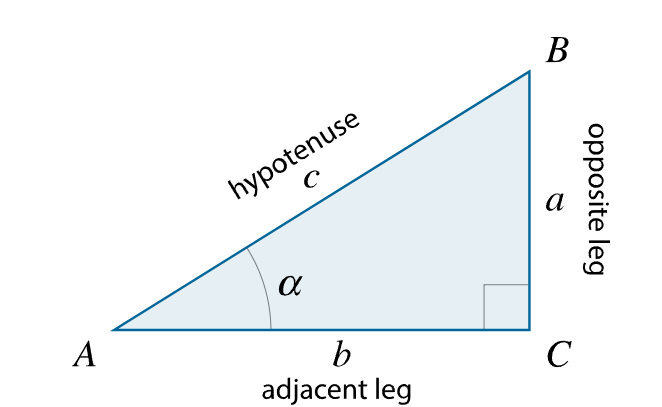
| Function | Definition |
|---|---|
| \(\sin(\alpha)\) | \(\frac{a}{c}\) |
| \(\cos(\alpha)\) | \(\frac{b}{c}\) |
| \(\tan(\alpha)\) | \(\frac{a}{b}\) |
Where \(a\) is the opposite side, \(b\) is the adjacent side, and \(c\) is the hypotenuse of a right triangle.
Basic Identities
\(\sin(x) = \frac{1}{\csc(x)}\)
\(\csc(x) = \frac{1}{\sin(x)}\)
\(\tan(x) = \frac{\sin(x)}{\cos(x)}\)
\(\cos(x) = \frac{1}{\sec(x)}\)
\(\sec(x) = \frac{1}{\cos(x)}\)
\(\cot(x) = \frac{\cos(x)}{\sin(x)}\)
\(\tan(x) = \frac{1}{\cot(x)}\)
\(\cot(x) = \frac{1}{\tan(x)}\)
Pythagorean Identities
Primary Identity
\(\sin^2(x) + \cos^2(x) = 1\)
\(\sin^2(x) = 1 - \cos^2(x)\)
\(\cos^2(x) = 1 - \sin^2(x)\)
Cosecant Identity
\(\csc^2(x) - \cot^2(x) = 1\)
\(\csc^2(x) = 1 + \cot^2(x)\)
\(\cot^2(x) = \csc^2(x) - 1\)
Secant Identity
\(\sec^2(x) - \tan^2(x) = 1\)
\(\sec^2(x) = 1 + \tan^2(x)\)
\(\tan^2(x) = \sec^2(x) - 1\)
Sum and Difference Identities
\(\sin(x \pm y) = \sin(x)\cos(y) \pm \cos(x)\sin(y)\)
\(\cos(x \pm y) = \cos(x)\cos(y) \mp \sin(x)\sin(y)\)
\(\tan(x \pm y) = \frac{\tan(x) \pm \tan(y)}{1 \mp \tan(x)\tan(y)}\)
Cofunction Identities
\(\sin\left(\frac{\pi}{2} - x\right) = \cos(x)\)
\(\cos\left(\frac{\pi}{2} - x\right) = \sin(x)\)
\(\tan\left(\frac{\pi}{2} - x\right) = \cot(x)\)
\(\sec\left(\frac{\pi}{2} - x\right) = \csc(x)\)
\(\csc\left(\frac{\pi}{2} - x\right) = \sec(x)\)
\(\cot\left(\frac{\pi}{2} - x\right) = \tan(x)\)
\(\sin\left(x \pm \frac{\pi}{2}\right) = \pm \cos(x)\)
\(\cos\left(x \pm \frac{\pi}{2}\right) = \mp \sin(x)\)
Double Angle Identities
\(\sin(2x) = 2\sin(x)\cos(x)\)
\(\cos(2x) = \cos^2(x) - \sin^2(x) = 1 - 2\sin^2(x) = 2\cos^2(x) - 1\)
\(\tan(2x) = \frac{2\tan(x)}{1 - \tan^2(x)}\)
\(\sin^2(x) = \frac{1 - \cos(2x)}{2}\)
\(\cos^2(x) = \frac{1 + \cos(2x)}{2}\)
\(\tan^2(x) = \frac{1 - \cos(2x)}{1 + \cos(2x)}\)
Half Angle Identities
\(\sin\left(\frac{x}{2}\right) = \pm \sqrt{\frac{1 - \cos(x)}{2}}\)
\(\cos\left(\frac{x}{2}\right) = \pm \sqrt{\frac{1 + \cos(x)}{2}}\)
\(\tan\left(\frac{x}{2}\right) = \pm \sqrt{\frac{1 - \cos(x)}{1 + \cos(x)}} = \frac{\sin(x)}{1 + \cos(x)} = \frac{1 - \cos(x)}{\sin(x)}\)
Product to Sum and Sum to Product Identities
Product to Sum
\(\sin(x)\sin(y) = \frac{1}{2}[\cos(x-y) - \cos(x+y)]\)
\(\cos(x)\cos(y) = \frac{1}{2}[\cos(x-y) + \cos(x+y)]\)
\(\sin(x)\cos(y) = \frac{1}{2}[\sin(x+y) + \sin(x-y)]\)
Sum to Product
\(\sin(x) + \sin(y) = 2\sin\left(\frac{x+y}{2}\right)\cos\left(\frac{x-y}{2}\right)\)
\(\cos(x) + \cos(y) = 2\cos\left(\frac{x+y}{2}\right)\cos\left(\frac{x-y}{2}\right)\)
\(\sin(x) - \sin(y) = 2\cos\left(\frac{x+y}{2}\right)\sin\left(\frac{x-y}{2}\right)\)
Inverse Trigonometric Functions
\(\sin^{-1}(x) = \arcsin(x)\), where \(x = \sin(y)\)
\(\cos^{-1}(x) = \arccos(x)\), where \(x = \cos(y)\)
\(\tan^{-1}(x) = \arctan(x)\), where \(x = \tan(y)\)
\(\sin(\sin^{-1}(x)) = x\)
\(\cos(\cos^{-1}(x)) = x\)
\(\tan(\tan^{-1}(x)) = x\)
Law of Sines
\(\frac{a}{\sin(A)} = \frac{b}{\sin(B)} = \frac{c}{\sin(C)} = 2R\)
Where \(R\) is the radius of the circumcircle of the triangle
Area Formulas
\(\text{Area} = \frac{1}{2}bc\sin(A) = \frac{1}{2}ab\sin(C) = \frac{1}{2}ac\sin(B)\)
Use Law of Sines for:
AAS, ASA, SSA (ambiguous case)
Law of Cosines
\(a^2 = b^2 + c^2 - 2bc\cos(A)\)
\(\cos(A) = \frac{b^2 + c^2 - a^2}{2bc}\)
\(A = \cos^{-1}\left(\frac{b^2 + c^2 - a^2}{2bc}\right)\)
Use Law of Cosines for:
SAS, SSS
Heron's Formula
Semi-perimeter: \(s = \frac{a + b + c}{2}\)
\(\text{Area} = \sqrt{s(s-a)(s-b)(s-c)}\)
Inradius: \(r = \frac{\sqrt{(s-a)(s-b)(s-c)}}{s}\)
Complex Numbers
Basic Definition
A complex number: \(Z = a + bi\)
Where \(a\) is the real part and \(b\) is the imaginary part
Absolute Value (Modulus)
\(|Z| = |a + bi| = \sqrt{a^2 + b^2}\)
Example: \(|3 + 4i| = \sqrt{3^2 + 4^2} = \sqrt{25} = 5\)
Trigonometric (Polar) Notation
\(a = r\cos(\theta)\)
\(b = r\sin(\theta)\)
\(r = |Z| = \sqrt{a^2 + b^2}\) (distance to origin)
\(a + bi = r(\cos(\theta) + i\sin(\theta)) = r\text{cis}(\theta)\)
Example: \(4 + 4i = 4\sqrt{2}\text{cis}\left(\frac{\pi}{4}\right)\)
Complex Multiplication
\(r_1\text{cis}(\theta_1) \cdot r_2\text{cis}(\theta_2) = r_1r_2\text{cis}(\theta_1 + \theta_2)\)
Complex Division
\(\frac{r_1\text{cis}(\theta_1)}{r_2\text{cis}(\theta_2)} = \frac{r_1}{r_2}\text{cis}(\theta_1 - \theta_2)\)
DeMoivre's Theorem
\((r\text{cis}(\theta))^n = r^n\text{cis}(n\theta)\)
Example: \((1+i)^9 = \sqrt{2}\text{cis}(45°)^9 = 2^{9/2}\text{cis}(405°) = 16\sqrt{2}\text{cis}(45°) = 16 + 16i\)
Nth Roots of Complex Numbers
\((r\text{cis}(\theta))^{1/n} = r^{1/n}\text{cis}\left(\frac{\theta + k \cdot 360°}{n}\right)\)
Where \(k = 0, 1, 2, \ldots, n-1\)
Combinatorics
Fundamental Counting Principle
If an event can be performed in \(n_1\) ways, a second in \(n_2\) ways, etc., then the total number of ways is:
\(n_1 \cdot n_2 \cdot n_3 \cdot \ldots \cdot n_k\)
Example: A 5-digit number has \(10 \cdot 10 \cdot 10 \cdot 10 \cdot 10 = 100,000\) combinations
Permutations
Permutation of all n objects:
\(_nP_n = n(n-1)(n-2)\ldots(3)(2)(1) = n!\)
Permutations of n objects taken k at a time:
\(_nP_k = \frac{n!}{(n-k)!}\)
Order matters (abc ≠ bac)
Combinations
\(_nC_k = \binom{n}{k} = \frac{n!}{k!(n-k)!}\)
Order does not matter (abc = bac = cab)
Pascal's Triangle & Binomial Coefficients
Used to expand \((a + b)^n\):
\((a + b)^0 = 1\)
\((a + b)^1 = a + b\)
\((a + b)^2 = a^2 + 2ab + b^2\)
\((a + b)^3 = a^3 + 3a^2b + 3ab^2 + b^3\)
\((a + b)^4 = a^4 + 4a^3b + 6a^2b^2 + 4ab^3 + b^4\)
Key Identity:
\(\binom{n}{k} = \binom{n}{n-k}\)
Limits
Theorem 1: Linear Function Limit
If \(f(x) = mx + b\), then \(\lim_{x \to a} f(x) = ma + b\)
Theorem 2: Uniqueness
If \(f(x)\) has a limit as \(x\) approaches \(a\), that limit is unique.
Theorem 3: Limit of Sums
If \(\lim_{x \to a} f(x) = L_1\) and \(\lim_{x \to a} g(x) = L_2\), then \(\lim_{x \to a} [f(x) + g(x)] = L_1 + L_2\)
Theorem 4: Limit of Products
If \(\lim_{x \to a} f(x) = L_1\) and \(\lim_{x \to a} g(x) = L_2\), then \(\lim_{x \to a} [f(x) \cdot g(x)] = L_1 \cdot L_2\)
Corollary 1:
\(\lim_{x \to a} [k \cdot f(x)] = k \cdot L_1\) (where \(k\) is a constant)
Corollary 2:
\(\lim_{x \to a} x^n = a^n\)
Corollary 3:
If \(f(x) = c_0x^n + c_1x^{n-1} + c_2x^{n-2} + \ldots + c_n\), then \(\lim_{x \to a} f(x) = c_0a^n + c_1a^{n-1} + c_2a^{n-2} + \ldots + c_n\)
Theorem 5: Limit of Quotients
If \(\lim_{x \to a} g(x) = L \neq 0\), then \(\lim_{x \to a} \frac{1}{g(x)} = \frac{1}{L}\)
Corollary 1:
If \(\lim_{x \to a} f(x) = L_1\) and \(\lim_{x \to a} g(x) = L_2 \neq 0\), then \(\lim_{x \to a} \frac{f(x)}{g(x)} = \frac{L_1}{L_2}\)
Derivatives
Definition of the Derivative
\(\frac{df(x)}{dx} = \lim_{h \to 0} \frac{f(x+h) - f(x)}{h}\)
Also written as \(f'(x)\) (Lagrange notation)
Example: \(f(x) = x^2\)
\(\frac{df}{dx} = \lim_{h \to 0} \frac{(x+h)^2 - x^2}{h} = \lim_{h \to 0} \frac{x^2 + 2xh + h^2 - x^2}{h} = \lim_{h \to 0} \frac{2xh + h^2}{h} = \lim_{h \to 0} (2x + h) = 2x\)
Basic Derivative Identities
\(\frac{d}{dx}(k) = 0\) (constant)
\(\frac{d}{dx}(x^n) = nx^{n-1}\)
\(\frac{d}{dx}(\sin x) = \cos x\)
\(\frac{d}{dx}(\cos x) = -\sin x\)
\(\frac{d}{dx}(\tan x) = \sec^2 x\)
\(\frac{d}{dx}(\ln x) = \frac{1}{x}, \quad x > 0\)
\(\frac{d}{dx}(\sec x) = \sec x \tan x\)
\(\frac{d}{dx}(\arcsin x) = \frac{1}{\sqrt{1-x^2}}\)
\(\frac{d}{dx}(\arccos x) = -\frac{1}{\sqrt{1-x^2}}\)
\(\frac{d}{dx}(\arctan x) = \frac{1}{1+x^2}\)
\(\frac{d}{dx}(a^x) = \ln(a) \cdot a^x\)
Proof: Take logarithm of \(y = a^x\) and use implicit differentiation
Constant Multiple Rule
\(\frac{d}{dx}[k \cdot f(x)] = k \cdot \frac{d}{dx}f(x)\)
Example: \(\frac{d}{dx}(5\sin x) = 5\cos x\)
Product Rule
\(\frac{d}{dx}[f(x) \cdot g(x)] = f(x) \cdot \frac{d}{dx}g(x) + \frac{d}{dx}f(x) \cdot g(x)\)
Or: \((fg)' = f'g + g'f\)
Quotient Rule
\(\frac{d}{dx}\left[\frac{f(x)}{g(x)}\right] = \frac{\frac{d}{dx}f(x) \cdot g(x) - f(x) \cdot \frac{d}{dx}g(x)}{g^2(x)}\)
Or: \(\left(\frac{f}{g}\right)' = \frac{f'g - g'f}{g^2}\)
Reciprocal Rule
\(\frac{d}{dx}\left[\frac{1}{f(x)}\right] = -\frac{\frac{d}{dx}f(x)}{f^2(x)}\)
Or: \(\left(\frac{1}{f}\right)' = -\frac{f'}{f^2}\) (derived from quotient rule)
Chain Rule
\([f(g(x))]' = f'(g(x)) \cdot g'(x)\)
Example: \(\frac{d}{dx}[\sin(x^3)] = \cos(x^3) \cdot 3x^2 = 3x^2\cos(x^3)\)
Practice Problems
1. \(f(x) = 6x^2 + 7x\)
2. \(g(t) = (4t^2 - 3t + 2)^{-2}\)
3. \(y = \frac{3}{1-8z}\)
4. \(R(w) = \csc(7w)\)
5. \(G(x) = 2\sin(3x) + \tan(x)\)
6. \(h(u) = \tan(4 + 10u)\)
7. \(f(t) = 5 + e^{4t} + t^7\)
8. \(g(x) = e^{1-\cos x}\)
9. \(H(z) = \frac{2}{1-6z}\)
10. \(u(t) = \tan^{-1}(3t-1)\)
SI Prefixes and Powers of 10
| Prefix | Multiple | Symbol |
|---|---|---|
| yotta | \(10^{24}\) | Y |
| zetta | \(10^{21}\) | Z |
| exa | \(10^{18}\) | E |
| peta | \(10^{15}\) | P |
| tera | \(10^{12}\) | T |
| giga | \(10^{9}\) | G |
| mega | \(10^{6}\) | M |
| kilo | \(10^{3}\) | k |
| hecto | \(10^{2}\) | h |
| deca | \(10^{1}\) | da |
| deci | \(10^{-1}\) | d |
| centi | \(10^{-2}\) | c |
| milli | \(10^{-3}\) | m |
| micro | \(10^{-6}\) | μ |
| nano | \(10^{-9}\) | n |
| pico | \(10^{-12}\) | p |
| femto | \(10^{-15}\) | f |
| atto | \(10^{-18}\) | a |
| zepto | \(10^{-21}\) | z |
| yocto | \(10^{-24}\) | y |